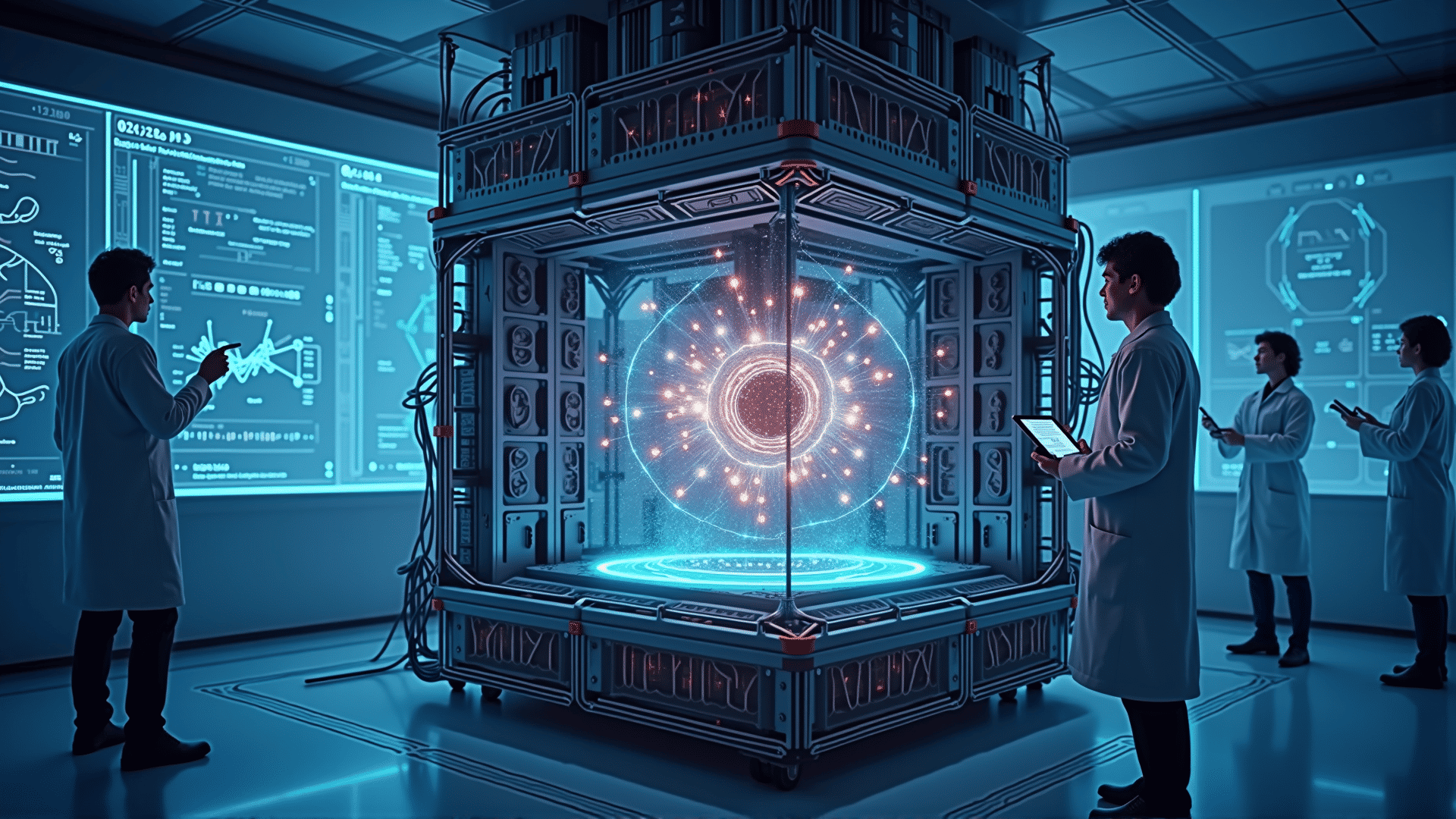
Quantum computing is rapidly transforming from a realm of theoretical exploration into a forefront technology with the potential to revolutionize numerous scientific domains. This burgeoning field promises to tackle complex problems with unprecedented speed and efficiency, ushering in a new era of computational capability.
At its core, quantum computing harnesses principles of quantum mechanics, a branch of physics that studies energy and matter at the most fundamental level. Unlike classical computers that use bits as the smallest unit of data, quantum computers use qubits. These qubits possess the unique ability to exist in multiple states simultaneously, thanks to quantum superposition. Additionally, they can be entangled, allowing for intricate connections between qubits that exponentially amplify computation power.
This fundamental distinction allows quantum computers to process vast amounts of data and perform calculations at speeds that are currently unimaginable with classical computers. For instance, problems that might take classical computers millions of years to solve could potentially be addressed in mere seconds with quantum computing. This opens up new possibilities for solving complex scientific problems, from drug discovery and molecular modeling to materials science and cryptography.
In the realm of drug discovery, for instance, quantum computing could simulate molecular interactions at an atomistic level, unveiling new pathways for developing more effective pharmaceuticals. By modeling these interactions rapidly and accurately, researchers can accelerate the discovery of new drugs, potentially leading to breakthroughs in treating complex diseases.
In materials science, quantum computers enable the design of novel materials with tailored properties. By understanding and predicting atomic interactions, researchers can develop materials with enhanced strength, durability, or conductivity, leading to innovations that can transform industries ranging from electronics to renewable energy.
Moreover, quantum computing holds the potential to revolutionize cryptography. Classical cryptographic systems, which underpin much of our current digital security, rely on the difficulty of solving specific mathematical problems. Quantum computers could crack these problems with ease, prompting the need for new, quantum-resistant cryptographic methodologies.
Despite its immense promise, quantum computing still faces significant challenges. Building stable and scalable quantum computers requires overcoming technical obstacles such as qubit error rates and maintaining coherence. However, ongoing advancements in quantum error correction and new quantum architectures are steadily paving the way toward more robust quantum systems.
Beyond the scientific and technical challenges, there are also broader questions about the societal and ethical implications of quantum computing. As with any revolutionary technology, careful consideration is required to ensure its benefits are equitably shared and its risks mitigated.
Collaboration will play a pivotal role in the quantum journey. Governments, academia, and private industry must forge partnerships to create the infrastructure, talent, and governance systems that will allow quantum computing to thrive safely and sustainably.
In conclusion, quantum computing represents a paradigm shift in our ability to tackle complex scientific problems. As we continue to break barriers in this groundbreaking field, the potential to reshape the future of research becomes not just a possibility, but an inevitable reality. By embracing the challenges and opportunities of quantum computing, we stand on the brink of an era defined by rapid advancements and innovations that have the power to transform how we understand and interact with the world around us.